Threat model: the EHDS Integration Hub
STRIDE, for the hub as it runs on Azure Container Apps: the UI and its API
(Next.js 15), Keycloak 26.8, the neo4j-proxy, the EDC-V connectors with their
IdentityHub and IssuerService, Neo4j 5.26 and the PostgreSQL Flexible Server.
Written 2026-10-16; each mitigation names the code, the test or the decision
that shows it. The app that connects to the hub has its own model,
threat-model-klarbefund.md. What the project
tested and found is the
security test report; how the platform
would be run for real data is the
operational guideline.
The data on the hub is synthetic: 127 generated patients, fictional organisations, forged load-test sessions. The threats below are assessed as if the data were real, because the hub is a reference implementation for a platform that will hold real data; where a mitigation is enough for the demo and not for real data, the table says so.
How to read this model
STRIDE asks six questions of every data flow: can the sender be spoofed, the data tampered with, the action repudiated, information disclosed, the service denied, privilege elevated. The system context in section 1 numbers the data flows and the trust boundaries they cross; the sequence in section 3 shows one complete exchange with the id of every threat at the step where it would happen; the six tables then hold one row per threat with the flow it sits on, its status, and the mitigation with the evidence. The evidence is a file, a test, a script or a decision in this repository, so each row can be checked without asking anyone.
Four attackers are assumed, and every row names at least one implicitly by its flow:
| Attacker | Reaches | Holds | Wants |
|---|---|---|---|
| Anyone on the internet | B1: the hub's pages and API, Keycloak's sign-in | Nothing; or a leaked cookie, token or password | A patient's record, a session, the admin console, the platform offline |
| A signed-in participant | B1 with a valid session, as its role | A legitimate account in one role | Data outside its role or its permit, another patient's record, a louder voice than its rate limit |
| A peer connector | B2 through the public control plane | Its own DID and credentials; forged or stolen ones | A contract it is not entitled to, data without an agreement, a false identity |
| An insider with operator rights | B2 and B3 through az, gh and the scripts |
Subscription rights, the deploy identity, the admin password | Secrets, a silent change, a cleared audit trail |
A fifth, the supply chain, has no flow of its own: a compromised dependency or image arrives through the deploy (F7) and is treated under tampering (T-07).
1. System context: data flows and trust boundaries
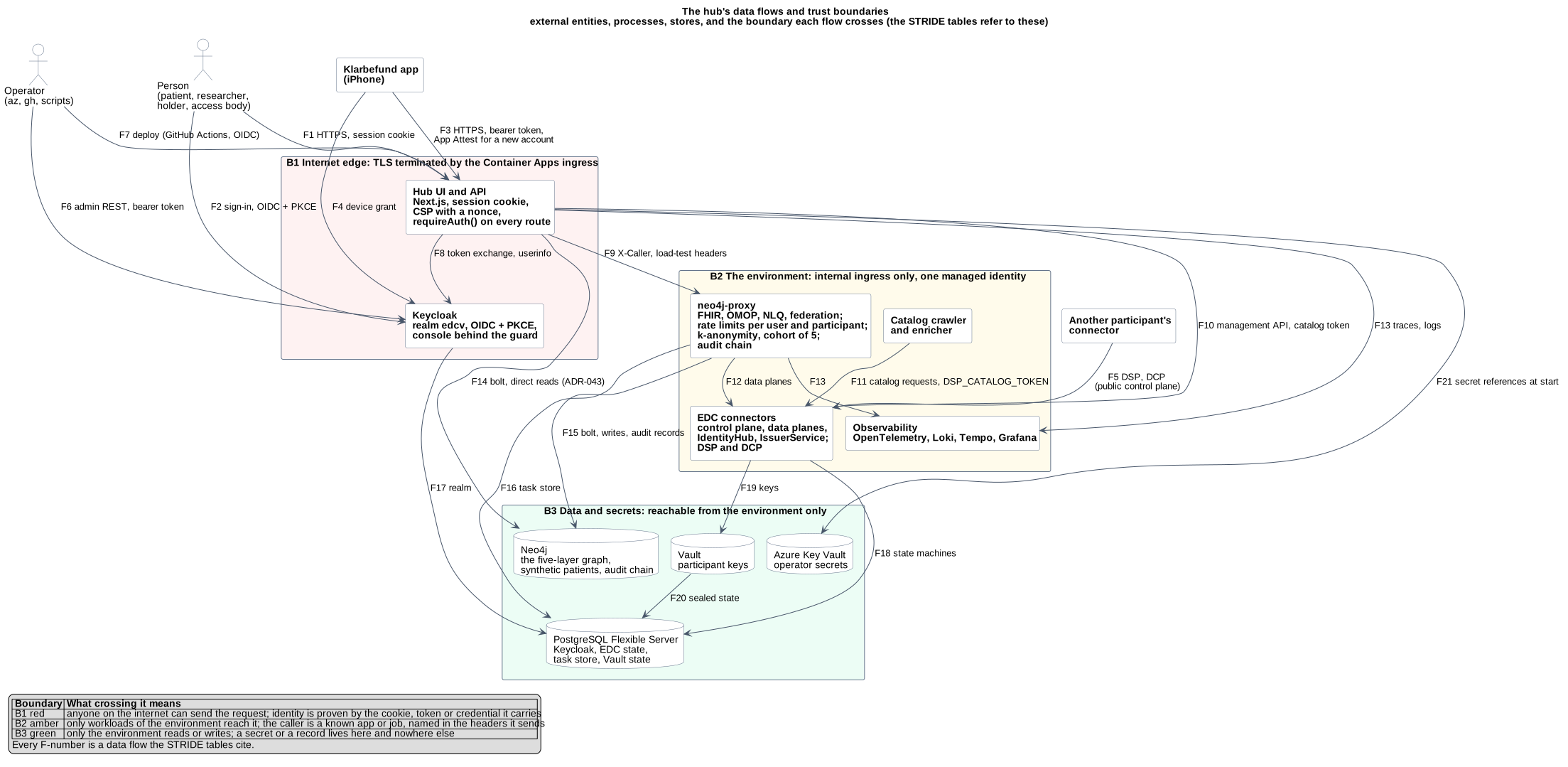
Source: diagrams/hub-trust-boundaries.puml,
rendered with scripts/render-plantuml.sh.
Three boundaries, and what crossing each one means:
| Boundary | Who can send a request across it | What proves identity |
|---|---|---|
| B1, the internet edge | Anyone | The session cookie (NextAuth JWT), a bearer token from Keycloak, or a DCP credential |
| B2, the environment | The hub's own apps and jobs, over internal ingress | The caller header the hub sets (X-Caller), the catalog token, the connector's DID |
| B3, data and secrets | The environment only | The managed identity (Key Vault references), the Vault token, the database credentials |
The numbered flows (F1 to F21) are what the STRIDE tables refer to. The ones that matter most, and why:
| Flow | What crosses | Why it is the one to watch |
|---|---|---|
| F1 | Every page and API request, with the session cookie | The only path an anonymous attacker has to the data; every route behind it needs a session (ADR-044) |
| F2, F8 | Sign-in and the token exchange with Keycloak | A forged or over-scoped token is a forged identity for everything downstream |
| F3, F4 | The app's bearer token and its account creation | A phone is outside anyone's control; App Attest is what keeps account creation to the genuine app |
| F5 | DSP and DCP between connectors | The one flow where a stranger's software talks to ours by design; identity is the DID and the credential, not a login |
| F9 | The hub's call to the proxy, with the caller header | The proxy trusts the header because only the hub can reach it; the boundary B2 is what makes that trust sound |
| F10, F11 | The management API and the catalog token | Full control of the connectors; internal ingress and one token in Key Vault are the whole defence |
| F14, F15 | Reads and writes to the graph, and the audit records | Where the patient data and the evidence live; parameterised queries and the hash chain are the controls |
| F19 to F21 | Keys and secrets | Vault, its sealed state and Key Vault; nothing here is ever copied into an app |
2. Assets
| Asset | Sensitivity | Where it lives | Notes |
|---|---|---|---|
| Patient records (FHIR, OMOP) | High | Neo4j (B3) | Synthetic today; the model treats them as real |
| Who read whose record, the audit chain | High | Neo4j, hash-chained (B3) | Regulatory evidence (Art. 73); ten years (retention policy) |
| Participant signing keys | High | Vault, state on the Flexible Server (B3) | Never leave Vault; ADR-046 |
Operator secrets: NEXTAUTH_SECRET, DB and admin passwords, the catalog token |
High | Azure Key Vault, referenced by the apps (B3) | ADR-036; the live NEXTAUTH_SECRET was rotated after it had been a published default |
| Sessions and tokens | High | Cookie in the browser, bearer in the app | NextAuth JWT; Keycloak access and refresh tokens |
| Verifiable credentials and permits | Medium | IdentityHub (B2) | Membership, EHDS participant, purpose, quality label, the permit as a credential |
| Contracts, transfers, tasks | Medium | EDC state in PostgreSQL (B3), mirrored to Neo4j | ODRL policies, agreements, TransferEvent nodes |
| Catalogue metadata | Low | Neo4j, the connectors | HealthDCAT-AP; public by design |
| The graph schema and the code | Low | GitHub, public | The documentation is the schema |
3. STRIDE
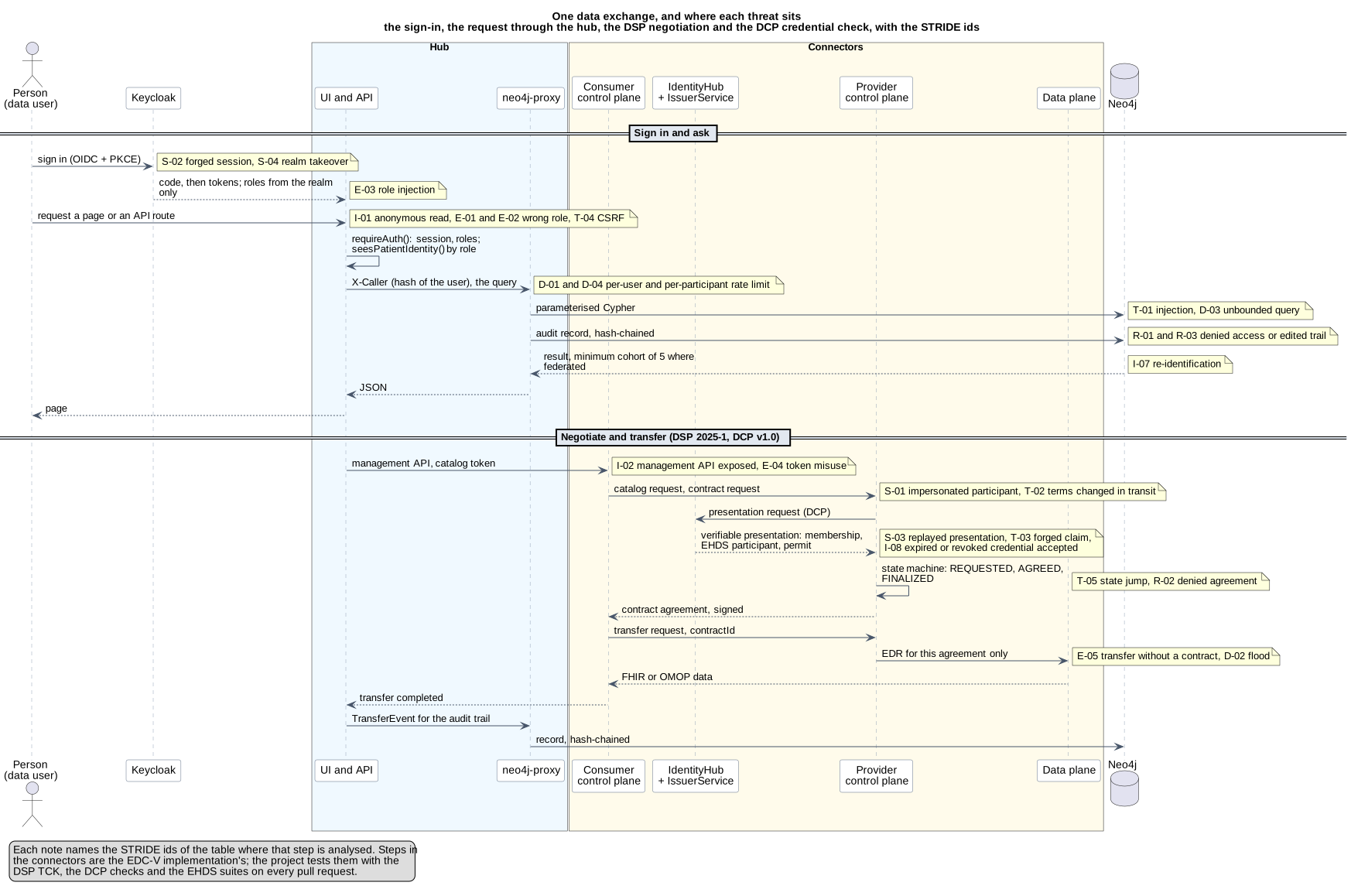
Source: diagrams/hub-exchange-threats.puml.
Status: closed means a test or a build setting pins it; in place means the code does it and a test exercises it indirectly; demo means enough for synthetic data and named as open for real data; open means nothing does it yet.
Spoofing
| ID | Threat | Flow | Status | Mitigation and evidence |
|---|---|---|---|---|
| S-01 | A connector impersonates a participant | F5 | In place | did:web resolution against the IdentityHub's DID document, one per participant; the DCP presentation carries the membership credential (ADR-007, ADR-009). Checked by scripts/run-ehds-identity-checks.sh on every pull request. |
| S-02 | A forged session reaches an API route | F1 | Closed | NextAuth JWT signed with NEXTAUTH_SECRET from Key Vault; requireAuth() in every handler, pinned by ui/__tests__/unit/api/every-route-needs-a-session.test.ts (ADR-044). |
| S-03 | A replayed credential presentation | F5 | In place | The EDC-V DCP implementation binds the presentation to the request; the DCP checks of compliance.yml run it. Not re-verified by the hub itself. |
| S-04 | Keycloak realm or console takeover | F2, F6 | Closed | The admin console is off the internet (guard-keycloak-console.sh, F10 of the test report); the admin password lives in Key Vault; the realm is version-controlled and drift-checked (runbook). MFA on the admin is for the operator (guideline, identity). |
| S-05 | A fake Klarbefund creates accounts | F3 | In place | Account creation answers only a request whose Apple App Attest attestation verifies (ADR-054); the challenge is signed and lives five minutes. |
Tampering
| ID | Threat | Flow | Status | Mitigation and evidence |
|---|---|---|---|---|
| T-01 | Cypher injection | F14, F15 | Closed | Parameterised Cypher everywhere; the NLQ engine refuses a query that would read a patient's identity unless the UI says the role may (revealsPatientIdentity()); tests in services/neo4j-proxy/__tests__/. |
| T-02 | Contract terms changed in transit | F5 | In place | TLS at the edge; the agreement is signed by the provider's connector. Mutually authenticated DSP endpoints are a guideline item for real data. |
| T-03 | A forged credential claim | F5 | In place | Credentials are issued and verified by the IssuerService and IdentityHub (EDC-V); the hub shows, it does not re-sign. An HSM for the issuer key is a guideline item. |
| T-04 | Cross-site request forgery on a mutation | F1 | In place | SameSite=Lax session cookie (NextAuth); the CSP forbids inline scripts; no mutation reads its parameters from a GET. |
| T-05 | A state jump in the negotiation | F5 | In place | The state machines live in the EDC-V control plane (REQUESTED, AGREED, FINALIZED; transfers REQUESTED to COMPLETED) and are leased in PostgreSQL; the hub mirrors, it does not drive. The DSP 2025-1 TCK runs on every pull request. |
| T-06 | The audit trail edited | F15 | Closed | Each record carries the hash of its predecessor, SHA-256 over canonical JSON; verifyChain() reports any change, removal or reordering (ADR-045, audit-chain.ts). Both chains were intact after every load run. |
| T-07 | A supply-chain change in a dependency or an image | F7 | Closed | One CycloneDX bill per part, checked against the lockfiles; grype and trivy on every push; npm audit in pre-push with time-boxed exceptions; images pinned; CodeQL. SBOM, security-scan.yml. |
Repudiation
| ID | Threat | Flow | Status | Mitigation and evidence |
|---|---|---|---|---|
| R-01 | A party denies a transfer happened | F15 | Closed | TransferEvent with sender and receiver DID and timestamp, in the hash-chained dsp chain (ADR-045). |
| R-02 | A party denies agreeing to a contract | F5 | In place | The agreement is signed by the connector and stored in the EDC state; mirrored to the graph with its id. |
| R-03 | A read of a patient's record is denied or hidden | F14, F15 | Closed | Every access the proxy serves is an access event in the query chain; the patient sees who read their record on their own page; retention ten years (policy). |
| R-04 | An operator action leaves no trace | F6, F7 | In place | Keycloak login events kept seven days; deploys are GitHub Actions runs; every live step is a script under scripts/azure/ and recorded in the gotchas or an ADR. A SIEM is a guideline item. |
Information disclosure
| ID | Threat | Flow | Status | Mitigation and evidence |
|---|---|---|---|---|
| I-01 | An anonymous caller reads data | F1 | Closed | Every API route needs a session (ADR-044); the pages that read them are in PROTECTED_PATHS and redirect; 40 black-box checks of the live hub confirm the 401s and redirects (check-hub-blackbox.sh). |
| I-02 | The connectors' management API reachable from outside | F10 | In place | Internal ingress only; the UI reaches it by its internal name, pinned on every deploy (#648). The catalog crawler sends its token only to listed hosts. |
| I-03 | Secrets in the page or the repository | F1, F7 | Closed | Server-side environment only; Key Vault references (ADR-036); gitleaks in the hooks and in CI; a test asserts no secret reaches the HTML. |
| I-04 | Cross-site scripting exfiltrates a session | F1 | Closed | A per-request nonce in the CSP with strict-dynamic, no unsafe-inline for scripts; HttpOnly session cookie; headers pinned by next.config.js and checked black-box. The off-hours page missed some headers once (F8, observe). |
| I-05 | A database reachable from the internet | F14 to F20 | Closed | Neo4j, PostgreSQL and Vault have no public ingress; the Flexible Server allows the environment only. |
| I-06 | Clickjacking | F1 | Closed | X-Frame-Options: DENY and frame-ancestors 'none', black-box checked. |
| I-07 | Re-identification from a cohort | F9, F12 | In place | MIN_COHORT_SIZE of 5 in the proxy for federated queries; roles other than the holder and the operator see a pseudonym, the birth year and no residence (#475). Output control by the access body is a process the demo does not run. |
| I-08 | An expired or revoked credential accepted | F5 | Demo | The IdentityHub checks expiry; there is no revocation list in the demo. Status lists and a revocation procedure are guideline items for real data. |
| I-09 | Logs carry personal data | F13 | In place | The proxy logs counts and codes, the caller as a hash; Azure Monitor keeps 30 days; the operational logs are separate from the audit chain (ADR-045). |
Denial of service
| ID | Threat | Flow | Status | Mitigation and evidence |
|---|---|---|---|---|
| D-01 | One user exhausts the proxy | F9 | Closed | Per user: RATE_LIMIT_MAX requests and RATE_LIMIT_HEAVY_MAX analytical queries per RATE_LIMIT_WINDOW_MS; per participant ten times that for callers that name no user; the audit route has its own. Measured: 83.6 % refused before, 23.2 % after the per-user limit (2026-10-05). |
| D-02 | A flood of DSP messages at the connectors | F5 | Demo | The EDC-V control plane leases its state machines in PostgreSQL and times out; no rate limit at the connector's edge. A WAF and rate limits per hostname are guideline items. |
| D-03 | An unbounded query | F14, F15 | Closed | LIMIT on every list route; the graph views capped at the newest 30 access events (#580), which removed the one request that took the UI down at 90 concurrent users; every outbound call has a timeout. |
| D-04 | Load takes the platform down | F1 | In place | 400 users with no failed request (2026-10-06); the UI scales on an HTTP concurrency rule to six whole-core replicas (ADR-061); health checks on every image; a deploy waits while a load test runs. The latency SLOs break from 200 users; measured next. |
| D-05 | The stack is off | F1 | Accepted | Everything stops off hours by decision (ADR-053) and the UI says so; a 24x7 contract removes the schedule (guideline, availability). |
Elevation of privilege
| ID | Threat | Flow | Status | Mitigation and evidence |
|---|---|---|---|---|
| E-01 | A patient reaches an admin route | F1 | Closed | requireAuth(["EDC_ADMIN"]) on the admin routes, 403 for any other role; the role matrix in .claude/rules/api-conventions.md; Bruno folder 09 Access control asserts it against a real server. |
| E-02 | A researcher reads a patient's identity | F1, F9 | Closed | seesPatientIdentity() decides by role; refuseForeignRecord() answers 403 for another patient's record; the NLQ proxy refuses identity reads without the UI's header (#475). Bruno 09 Access control/28 to /30. |
| E-03 | Roles injected into the token | F2, F8 | Closed | Roles come from the realm's claims only; the UI client has full scope off and exactly the seven EHDS roles in scope (#648, wire-ui-client-scope.sh); auth.ts maps nothing else. |
| E-04 | The catalog token used from elsewhere | F10, F11 | In place | One token in Key Vault, reaching the UI and the crawler as a reference; the crawler sends it only to DSP_CATALOG_TOKEN_HOSTS; a wrong token is 401, never a fall back to the session (ADR-020, ADR-036). |
| E-05 | A transfer without an agreement | F5, F12 | In place | The data plane hands out an EDR for a finalised agreement only (EDC-V); the hub records the contractId with every transfer. The TCK covers the protocol. |
| E-06 | The operator account edcadmin on a demo password |
F2 | Open | EDC_ADMIN reads a patient's record without a contract negotiation. scripts/azure/secure-accounts.sh moves it and every non-demo account to a generated password in Key Vault; to be run against the live realm (#671). |
Summary
| Category | Threats | Closed | In place | Demo | Open | Accepted |
|---|---|---|---|---|---|---|
| Spoofing | 5 | 2 | 3 | 0 | 0 | 0 |
| Tampering | 7 | 3 | 4 | 0 | 0 | 0 |
| Repudiation | 4 | 2 | 2 | 0 | 0 | 0 |
| Information disclosure | 9 | 5 | 3 | 1 | 0 | 0 |
| Denial of service | 5 | 2 | 1 | 1 | 0 | 1 |
| Elevation of privilege | 6 | 3 | 2 | 0 | 1 | 0 |
| All | 36 | 17 | 15 | 2 | 1 | 1 |
Closed and in place differ in how they are proven: a closed row has a test or a build setting that fails when the mitigation goes; an in-place row relies on the code doing it and on the suites that exercise it. Turning in-place rows into closed ones is the ordinary work of this model.
4. What the demo accepts, and what real data needs
| Residual risk | Why it is accepted for the demo | What closes it |
|---|---|---|
| No revocation of credentials (I-08) | Every credential is issued to a fictional participant by the demo | A status list in the IssuerService and a revocation procedure; guideline, identity |
| No rate limit at the connectors' edge (D-02) | The connectors talk to fictional peers only | A WAF and per-hostname limits; guideline, edge |
| No mTLS between apps (T-02) | One environment, internal ingress | Private endpoints and mutually authenticated DSP endpoints; guideline, connectors |
| Neo4j has one database user | Access is decided in the hub and the proxy, and the data is synthetic | Neo4j Enterprise or a managed graph with roles and backups; guideline, data |
| Operator accounts on demo passwords (E-06) | Nobody's real data is behind them | secure-accounts.sh --all-non-demo; #671 |
| No independent test | The project's own tests are the evidence so far | A penetration test of the hub; test report, last section; #655 |
| The stack is off outside office hours (D-05) | A cost decision for a demo | A 24x7 service contract; guideline, availability |
5. How this model is kept true
- A new API route needs a session or a superseding ADR; the test
every-route-needs-a-session.test.tsfails otherwise. - A new route that returns patient fields asks
seesPatientIdentity()first, and the Bruno collection gets a request that asserts the refusal. - Every change runs the security scan, CodeQL, the compliance suites and the black-box checks; a finding goes into the security test report with a status, never only into a commit message.
- The diagrams are PlantUML sources under
diagrams/, rendered byscripts/render-plantuml.sh; a flow added to the system gets a number here and a row in the table that analyses it.
6. How to verify this model yourself
Every closed row has a check that can be run on a laptop or read in CI:
cd ui && npx vitest run __tests__/unit/api/every-route-needs-a-session.test.ts   # S-02, I-01, E-01
cd ui && npx vitest run __tests__/unit/api/patient-route.test.ts                   # E-02, I-07
scripts/security/check-hub-blackbox.sh                                             # I-01, I-04, I-06, S-04 against the live hub
scripts/security/scan-repo.sh                                                      # T-07: grype, npm audit, trivy, gitleaks, semgrep, hadolint, shellcheck
scripts/security/generate-sbom.sh --check                                          # T-07: the bills match the lockfiles
./scripts/run-api-tests.sh Azure-Dev "09 Access control"                           # E-01, E-02, E-04 by persona, against a real server
scripts/azure/guard-keycloak-console.sh --check                                    # S-04: console 403, admin REST 401, master realm 401
cd services/neo4j-proxy && npm test                                                # T-01, T-06, D-01, D-03
The compliance suites (compliance.yml: the DSP 2025-1 TCK, the DCP checks,
the EHDS suites) cover the connector rows, S-01, S-03, T-05, E-05, on every
pull request. A row whose check is missing from this list is an in-place row,
and the next step for it is the test that would move it.